
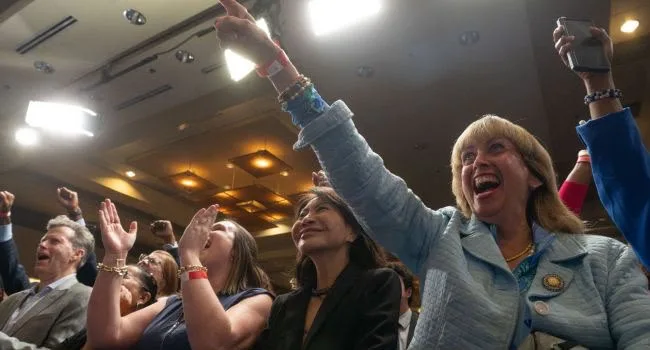
The Democratic Party has secured control of both chambers of the United States Congress following a sweeping victory in Tuesday’s midterm elections, dealing a major political setback to President Donald Trump and his Republican Party.
The outcome gives Democrats control of the House of Representatives and the Senate, placing them in a strong position to challenge Trump’s policies, block proposed legislation and launch investigations into his administration during the remaining two years of his presidency.
The electoral defeat was largely attributed to growing public dissatisfaction with the rising cost of living, the impact of trade tariffs and Trump’s military conflict with Iran, which has contributed to soaring fuel prices and heightened economic concerns.
Despite the defeat, Trump said he was prepared to respect the election outcome and work with the incoming Democratic leadership.
Speaking to The New York Times, the president said he was “absolutely willing to accept those results”, adding that he was ready to cooperate with Democrats.
However, shortly afterwards, he appeared to signal resistance to their legislative agenda by sharing an image of a red baseball cap bearing the word “VETO” on social media.
Democrats recorded significant victories in traditionally Republican states, including Kansas and Iowa, where they overturned long-standing Republican dominance in Senate contests.
In Kansas, Methodist minister Adam Hamilton defeated incumbent Republican Senator Roger Marshall, becoming the first Democrat to win a Senate seat in the state since 1932.
Iowa also returned a Democratic senator for the first time since 2008, further highlighting the scale of the party's gains in Republican strongholds.
The victories followed Democratic successes in Texas, South Carolina, North Carolina and Ohio, despite Trump's extensive campaign efforts to retain Republican support.
Texas recorded one of the most significant political upsets, with Democrat James Talarico defeating a Trump-backed candidate in the Senate race, while Gina Hinojosa unseated Republican Governor Greg Abbott.
Democrats also retained key Senate seats in Georgia and New Hampshire, strengthening their position in the chamber.
The party's six-seat gain was enough for election analysts to project a takeover of the Senate, where Republicans previously enjoyed a 53-47 majority.
The Democratic advance extended to the House of Representatives, where the party overturned several Republican-held seats across Pennsylvania, New Jersey, Kentucky, Arizona and North Carolina.
Some of the victories came in constituencies Trump had comfortably won during the 2024 presidential election, indicating a significant shift in voter sentiment.
In Indiana, Democrat J.D. Ford defeated Republican Congresswoman Victoria Spartz in a district Trump had carried by 17 percentage points in 2024.
Meanwhile, former Atlanta Mayor Keisha Lance Bottoms made history in Georgia by becoming the first Black woman elected governor in the United States.
Republicans, however, recorded some victories in Florida, where Trump-backed Byron Donalds won the governorship, becoming the state's first Black governor, while Ashley Moody retained her Senate seat.
Reacting to the results, George Washington University professor Todd Belt described the outcome as a major rejection of Trump's leadership and policies, pointing to concerns over the economy, alleged corruption and the conflict with Iran.
With control of Congress, Democrats are expected to use their new majority to scrutinise the Trump administration, particularly its handling of the Iran conflict, immigration enforcement and corruption allegations.
They will also have greater influence over judicial appointments, senior government nominations and the passage of federal legislation.
Democratic Congressman Robert Garcia, who is expected to head the powerful House Oversight Committee, issued a warning to Republicans following the results, posting on social media: “LAWYER UP.”
House Democratic leader Hakeem Jeffries also declared that Trump's Make America Great Again (MAGA) movement had suffered a nationwide setback.
Jeffries could become the first Black Speaker of the House when the new Congress begins sitting in January, subject to a vote by members of his party.
For many Americans, economic hardship remained a major factor in determining their votes, with concerns over increasing household expenses dominating the campaign.
A 24-year-old voter in Los Angeles, Taylor Cook, told AFP that rising rent, food prices, electricity bills and property taxes had become a major burden.