
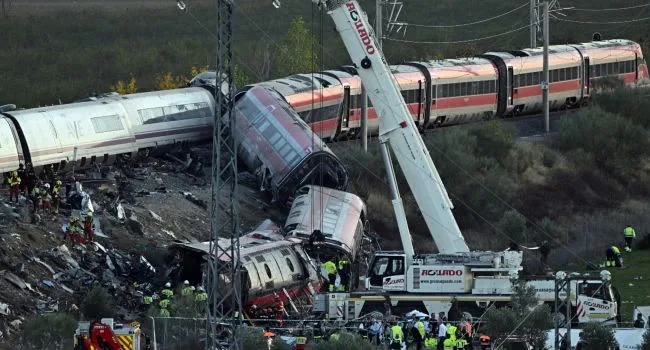
Spain has declared three days of national mourning following a high-speed train collision that killed 68 people and injured dozens of others, triggering renewed concerns over railway safety in the country.
The crash occurred on Wednesday morning in Castilla-La Mancha, central Spain, when a train operated by state-owned Renfe struck the rear of a stationary train belonging to private operator Iryo.
Emergency workers continued searching through the wreckage overnight, using cranes to lift twisted metal and recover victims along the railway line linking Madrid to Seville.
The disaster has left families anxiously seeking information about missing relatives, while support centres have been established to assist those affected.
A school in Urda, a village about 130 kilometres south of Madrid, was converted into a support centre where relatives could make enquiries about their loved ones. Red Cross personnel and psychologists were also deployed to provide emotional support.
Red Cross psychologist Carmen Garcia said families faced a difficult period of grief, noting that victims’ relatives were experiencing shock, anger, sadness and uncertainty.
The Civil Guard established offices in Madrid, Toledo, Cordoba and Seville to collect DNA samples from relatives and assist in identifying missing victims. Blood donation centres were also opened in Madrid and Castilla-La Mancha.
Survivors recounted terrifying moments during the collision. A 31-year-old Peruvian tourist, Josimar Medina, said he had been sleeping aboard the Renfe train when the impact threw him into the air.
Another survivor, 42-year-old Pablo Mejia, said a last-minute change of seat may have saved his life. He described scenes of passengers lying on top of one another, torn-out seats, scattered luggage and widespread confusion.
The crash has also raised questions about the management and safety of Spain’s railway network.
Transport Minister Oscar Puente said an automatic control system had failed along a 69-kilometre stretch of track, forcing train services in the affected area to stop.
He questioned the decision by the control centre to resume operations despite what he described as unexplained circumstances. According to the minister, the Renfe train travelled about 25 kilometres before colliding with the stationary Iryo train.
Puente added that the control centre had sufficient time to identify and correct the problem before allowing traffic to resume.
The latest incident is Spain’s second deadly high-speed rail collision this year. In January, 46 people were killed in a crash in the