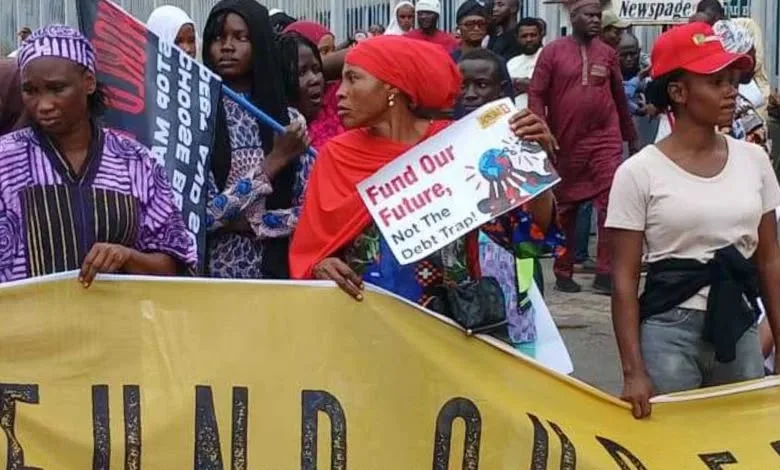
Protesters on Thursday converged on the Federal Ministry of Finance in Abuja, calling on the Federal Government to halt its continued reliance on borrowing to fund development and other government programmes.
The demonstration was organised with the participation of ActionAid Nigeria, market women, university students and other civil society groups, who gathered at the ministry’s entrance to express concern over Nigeria’s rising debt burden and the economic consequences of increased borrowing.
The protesters urged the Federal Government to reconsider plans to secure additional loans, while appealing to the World Bank and the International Monetary Fund (IMF) to stop granting further loans to Nigeria.
They also called on the international financial institutions to “let Nigeria breathe,” arguing that continued accumulation of debt could further increase the financial pressure on citizens.
According to the demonstrators, Nigeria’s debt situation should be considered alongside the economic difficulties facing households, businesses and other vulnerable groups across the country.
They therefore urged the government to explore alternative sources of funding, strengthen domestic revenue generation and implement policies capable of reducing the economic burden on Nigerians.
The protest comes amid an ongoing debate over Nigeria’s borrowing strategy and the country’s engagement with international development institutions.
In August, the Minister of Finance and Coordinating Minister of the Economy, Taiwo Oyedele, criticised Nigerians who attacked the World Bank on social media over its continued lending to the country.
Oyedele said the backlash showed that some Nigerians did not fully understand how development financing works, adding that the World Bank had been forced to disable comments on its social media platforms after Nigerians criticised the institution over loans approved for Nigeria.
“People went to the social media account of the World Bank to go and be abusing them that they’re giving Nigeria loan. World Bank just switch off the comments. We’ve gotten the loan because that’s not how the system works,” he said.
The minister explained his position using an automated teller machine (ATM) analogy, saying public anger could be misdirected when people did not understand how a system operated.
“Some people who have no knowledge of how it works. They said why is government allowing some people withdraw money here and they’re not giving to the rest of us,” Oyedele said.
He further likened the situation to people destroying an ATM because they wanted access to money without understanding that funds had to first be available in the bank.
“So some leaders emerged from their group and said this is not fair government has to and then they went and destroyed the ATM, beat up some other people withdrawing money there and they were hailing their hero,” he said.
Oyedele added, “Yes, let everybody withdraw money from the ATM. They haven’t put money in the bank.”
According to the minister, attacking the mechanism through which funds were accessed would not solve the underlying problem of the absence of money.
“After breaking the bank and the ATM and beating people up, they still can’t collect money ’cause that’s not how the system works,” he said.
He urged Nigerians to seek a better understanding of public finance and government processes, saying such knowledge was necessary for effective engagement and accountability.
“If you don’t understand how the system works, you waste energy,” Oyedele said.
He added, “Part of your ability to hold government to account is having the right knowledge. If you don’t, you’re wasting your energy.”
The finance minister had also acknowledged in May that Nigeria needed to reduce its dependence on borrowing, stressing the importance of strengthening the country’s fiscal system and increasing domestic revenue to sustainably finance infrastructure and other government priorities.
Meanwhile, the World Bank continues to finance projects and programmes in Nigeria covering areas including electricity, social protection, education, healthcare and economic reforms.
In July, the Federal Government launched World Bank-supported programmes worth $3.05 billion, with the initiatives focused on vulnerable communities, human capital development and social protection.
The government has consistently maintained that its external borrowing is tied to specific development programmes and projects, rather than being obtained without designated purposes.