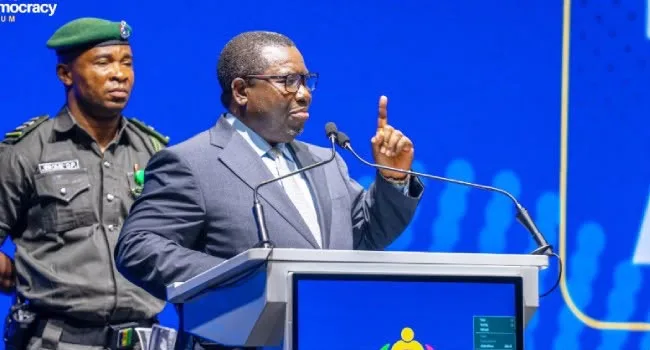
The Chairman of the Independent National Electoral Commission (INEC), Prof. Joash Amupitan, has reaffirmed his commitment to conducting impartial elections, declaring that his allegiance is to the Nigerian Constitution and the Electoral Act rather than any political party or interest.
Amupitan made the declaration on Thursday, November 12, 2026, during a high-level dialogue organised in partnership with the Kimpact Development Initiative (KDI) at Chatham House, London.
The event, themed “Nigeria’s 2027 Elections: Democratic Trajectory and Regional Stability Beyond the Ballot,” provided an opportunity for the INEC chairman to address concerns surrounding his neutrality and the credibility of the commission ahead of the 2027 general elections.
His remarks came amid controversy over an X account allegedly linked to him, which reportedly published a post expressing support for the ruling All Progressives Congress (APC) during the 2023 general elections.
However, INEC had denied that Amupitan operated the account, describing the development as an attempt at digital impersonation.
Addressing the allegation, the chairman said he did not operate the account and disclosed that an independent forensic examination had been conducted, while the matter had been referred to the Department of State Services (DSS) and the Inspector-General of Police for investigation.
Emphasising his commitment to neutrality, Amupitan said his responsibility was to uphold the country’s legal framework and ensure that all political actors were treated fairly.
“My loyalty is solely to the Constitution of the Federal Republic of Nigeria and the Electoral Act,” he said.
He maintained that every constitutional institution, including the Presidency, National Assembly and state governments, was bound by the principles of constitutionalism and the rule of law.
The INEC chairman also dismissed concerns that his previous involvement in political cases as a legal practitioner could affect his impartiality, explaining that he had acted in his professional capacity as a Senior Advocate of Nigeria before his appointment.
He appealed to Nigerians to give the commission the opportunity to rebuild public confidence and deliver free, fair and credible elections in 2027.
Reflecting on the 2023 general elections, Amupitan acknowledged that the controversies surrounding the presidential poll had significantly weakened public trust in INEC, adding that the commission was yet to fully overcome the setback.
“First and foremost, let me speak about what happened in 2023, which resulted in a significant trust deficit for INEC—damage so large that the Commission has not yet fully recovered from it,” he said.
He, however, noted that the commission had drawn lessons from subsequent off-cycle elections, particularly those conducted in Anambra and Osun states, where results were announced the day after voting.
Amupitan identified insecurity, logistics and effective result management as key challenges requiring attention ahead of the 2027 elections.
On concerns over irregularities in the voters’ register, including claims of an 85 per cent increase in the number of registered voters in a ward in Ebonyi State, he said the commission had investigated the complaint and addressed it in accordance with established legal procedures.
He explained that the Electoral Act provides for public claims and objections regarding the voters’ register, as well as procedures for obtaining certified true copies of the document.
The INEC chairman also called on Nigerian youths to take an active interest in the country’s democratic process, stressing the importance of responsible participation and the need to tackle misinformation.
“This country belongs to young Nigerians, and they must not relent in working for the Nigeria they desire,” he said.
He warned that misinformation posed a serious threat to democracy and urged citizens to verify information before sharing it or acting on it, adding that public participation and confidence were essential to strengthening the electoral process.