By Fatima Abdullahi
The conflict in the Middle East intensified for a seventh consecutive night as Iran threatened to expand its military campaign following recent American strikes, while launching attacks on several locations linked to the United States military across the region.
Iran’s Revolutionary Guards warned that Tehran would begin what it described as a “full-scale offensive” if US military operations continued over the coming days. Senior military adviser to Iran’s Supreme Leader, Major General Mohsen Rezaei, said the country would no longer limit its response to proportional retaliation, warning that no political border would remain safe if the conflict persisted.
Iran also claimed responsibility for strikes targeting US military facilities in Kuwait, Jordan and Bahrain. According to Iranian state media, the attacks hit ammunition depots, fuel storage facilities, communication infrastructure and military bases used by American forces.
In Kuwait, authorities confirmed that an attack damaged a power and water facility, while the country’s military reported that several personnel were injured during drone strikes on military camps.
Jordan’s armed forces said they intercepted 10 Iranian missiles before they reached their targets, adding that there were no casualties or property damage. Bahrain also confirmed that air raid sirens were activated after missiles were detected in its airspace.
The Revolutionary Guards further claimed that two oil tankers exploded in the Strait of Hormuz after striking naval mines allegedly linked to American intelligence operations. The US military rejected the allegation. Iran also announced that it had stopped four vessels attempting to pass through the strategic waterway.
The Strait of Hormuz, one of the world’s busiest oil shipping routes, has witnessed a sharp decline in maritime traffic since hostilities escalated, raising fresh concerns over global energy supplies.
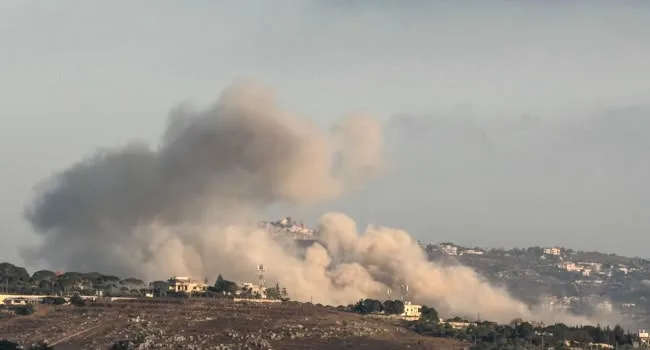
Meanwhile, the US Central Command said its forces carried out additional strikes aimed at degrading Iran’s military capabilities.
Iran accused the United States of targeting civilian infrastructure, including an airport, railway station and bridges. Iranian state media reported that at least three people were killed and eight others injured in Hormozgan Province following the latest strikes.
The fighting, which began on February 28 with coordinated US-Israeli attacks on Iranian targets, has expanded across the Gulf region, drawing in several neighbouring countries and threatening wider regional stability.
The conflict has also affected essential services inside Iran. Authorities said missile strikes disrupted electricity facilities and desalination plants in parts of the country’s south, leaving several communities without drinking water. Citizens have been urged to reduce electricity consumption as pressure mounts on the national power grid.
Iran also claimed to have targeted US radar installations in Qatar and Oman, as well as military assets in Syria. While Qatar said it intercepted an incoming missile, Syrian officials denied reports of an attack on the Al-Tanf military base.
Elsewhere, drone and rocket attacks in Iraq’s Kurdistan Region killed nine members of the Komala Party of Iranian Kurdistan, an exiled opposition group that blamed the assault on Iran.
Iran’s Health Ministry said the renewed fighting has killed at least 38 people and injured more than 400 others.
As the conflict continues to widen, international efforts to restore dialogue have intensified. China and Pakistan have called on both Washington and Tehran to halt military operations and return to negotiations in a bid to prevent a broader regional war.