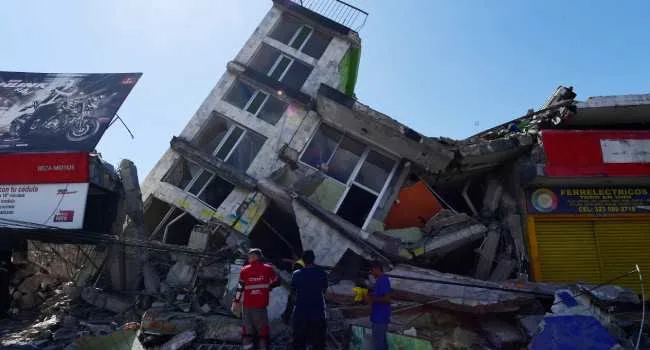
Colombia has declared a state of emergency after a powerful 7.4-magnitude earthquake struck the western part of the country, killing at least 111 people and leaving widespread destruction in its wake.
The earthquake struck at about 7:34 a.m. local time on Monday, with several cities reporting collapsed buildings, trapped residents and major damage to infrastructure.
President Abelardo de la Espriella, who assumed office only three days earlier, said the government had deployed emergency resources to protect residents and provide assistance to affected communities.
Authorities reported that at least 87 people were injured, while more than 1,000 buildings were damaged across the affected areas.
The epicentre was located in the coastal Chocó region at a depth of about 100 kilometres. Officials in the impoverished region confirmed 12 deaths, while neighbouring areas recorded significantly higher casualties.
Pereira and surrounding parts of Risaralda were among the hardest-hit locations, with officials reporting dozens of deaths.
In Manizales, part of a prominent cathedral tower was brought down by the tremor, while numerous other buildings were damaged.
Residents were left reluctant to return home amid fears of further tremors, while traffic was disrupted in several areas.
RESCUE TEAMS SEARCH FOR SURVIVORS
The disaster also caused major damage in Cali, Colombia’s third-largest city, where at least 20 buildings reportedly collapsed.
Emergency teams were deployed to search through the rubble for people believed to be trapped.
In Quibdó, the capital of Chocó, authorities reported extensive destruction, with residents describing a desperate situation involving deaths, injuries and a large number of people still unaccounted for.
The earthquake was also felt in neighbouring Ecuador, Panama and Venezuela.
In Bogotá, residents rushed out of buildings after feeling the strong tremors, with authorities carrying out evacuations as a precaution. Damage in the capital, however, was reported to be limited.
The earthquake also disrupted air travel, forcing six small airports in western Colombia to suspend operations. Football authorities subsequently postponed scheduled matches.
INTERNATIONAL SUPPORT OFFERED
The disaster has attracted offers of assistance from several countries and international organisations.
The United States said it was closely monitoring the situation and was prepared to assist Colombia, while the European Union offered support and activated its Copernicus satellite service to aid rescue and emergency operations.
Israel, Mexico, Ecuador and France also expressed their willingness to provide assistance.
The Colombian government is continuing rescue and relief operations as emergency workers assess the full scale of the destruction and search for those still missing.